Shilajit and Sea Moss: Do They Work Together?
Last reviewed June 2026 · 9 min read
Shilajit and sea moss are two of the most searched supplements in the wellness category right now. Both are positioned as mineral-rich, energy-supporting "superfoods" with deep traditional roots. Both have attracted enormous social media followings. And both are increasingly sold together — in capsules, gummies, honey sticks, and liquid drops — as a combination that brands claim offers synergistic benefits beyond either ingredient alone.
The question worth asking before you buy is the same one you should ask about any supplement combination: what does the evidence actually say — for each ingredient separately, and for the combination specifically? And what does adding sea moss to a shilajit product do to its transparency credentials?
What Sea Moss Is
Sea moss — most commonly referring to Chondrus crispus (Irish moss) or species from the Gracilaria genus — is a red algae harvested from Atlantic coastlines. It has been used in Caribbean and Irish folk traditions as a food thickener and general tonic for centuries.
In supplement marketing, sea moss is typically promoted on three claims:
- Mineral content. Sea moss contains iodine, potassium, calcium, magnesium, and other minerals — the oft-repeated claim that it contains "92 of the 102 minerals the human body needs" originates from Dr. Sebi, not from peer-reviewed nutritional analysis. Independent lab analyses show meaningful mineral content, but the specific profile varies significantly by species, harvest location, and preparation method.
- Carrageenan and prebiotic fibre. Sea moss is high in carrageenan, a sulfated polysaccharide, and in prebiotic fibre that may support gut microbiome diversity. This is the best-supported benefit in the research literature.
- Thyroid and immune support. The iodine content is relevant for thyroid function in individuals with dietary iodine deficiency. General immune claims are less well-supported in humans.
The Evidence for Sea Moss
The clinical evidence base for sea moss is thin compared to shilajit. Most research involves in-vitro studies, animal models, or observational data on carrageenan consumption in food contexts. There are no published randomised controlled trials in humans examining sea moss supplementation for the outcomes most commonly claimed — energy, immune function, or skin health.
What exists in the human literature:
- Very little. A gut microbiome pilot study in sea moss gel is sometimes cited, and we could not find it in PubMed or Europe PMC — the identifier usually attached to it belongs to an unrelated physics paper. Treat the prebiotic claim as untested in humans until a study surfaces.
- On iodine, the measured picture is narrower than the warnings suggest. A 2020 analysis of 30 red seaweed samples found Irish moss (Chondrus crispus, the species sold as sea moss) averaging 3.86 mg/kg dry weight, and concluded that 4 g a day does not pose a health risk — it supplies roughly a quarter of a child's recommended intake. It would take about 286 g a day to exceed the adult upper limit of 1,100 µg. Darias-Rosales J et al., Environ Sci Pollut Res Int 2020
Iodine still deserves attention, but for a narrower reason than "sea moss is dangerous". Excess iodine can trigger or worsen thyroid conditions including Hashimoto's disease and hyperthyroidism, and the measured content of a given product depends on species, harvest and how concentrated the gel or capsule is — none of which the label usually tells you. The sensible position is not alarm but arithmetic: if you have a thyroid condition, you want a product that states iodine per serving, because without it you cannot do the sum at all.
The Evidence for Shilajit
Shilajit's clinical evidence is considerably more robust than sea moss, with two well-designed randomised controlled trials in humans:
- Pandit et al. (2016) — healthy men aged 45–55 receiving 250 mg of purified shilajit twice daily for 90 days showed significant increases in total testosterone, free testosterone and DHEAS (the abstract gives no sample size or effect sizes). PubMed 26395129
- Keller et al. (2019) — healthy active men taking 500 mg/day for 8 weeks showed attenuation of fatigue-induced strength decline and lowered baseline serum hydroxyproline, within the stronger half of the sample only. PubMed 30728074
Both studies used standardised, independently tested shilajit at doses of 250–500 mg/day. The mechanisms — fulvic acid's role in mitochondrial support, mineral bioavailability, and potential LH stimulation — are biologically plausible and reasonably well characterised in the research literature. For a full review, see our shilajit evidence review for men and women.
The Claimed Synergy
Supplement brands typically promote the shilajit-sea moss combination on two claims:
- "Stacked mineral support." Both ingredients are mineral-rich, so combining them is promoted as delivering a broader or more complete mineral spectrum. This claim is superficially plausible — shilajit's ionic mineral complex and sea moss's mineral content do overlap but also differ — but no study has examined whether the combination improves mineral status more than either ingredient alone, or whether the combined mineral load causes any antagonism or excess intake for particular minerals.
- "Complementary adaptogens." Sea moss is frequently described as an adaptogen in marketing copy, though it does not meet the formal pharmacological definition of an adaptogen (a substance shown in clinical research to help the body maintain homeostasis under physical or psychological stress). Shilajit has better grounds for the adaptogen label, with fatigue and stress studies supporting it. Combining an evidence-backed adaptogen with a claimed-but-unverified one does not produce a more powerful adaptogen blend.
Bottom line on the synergy
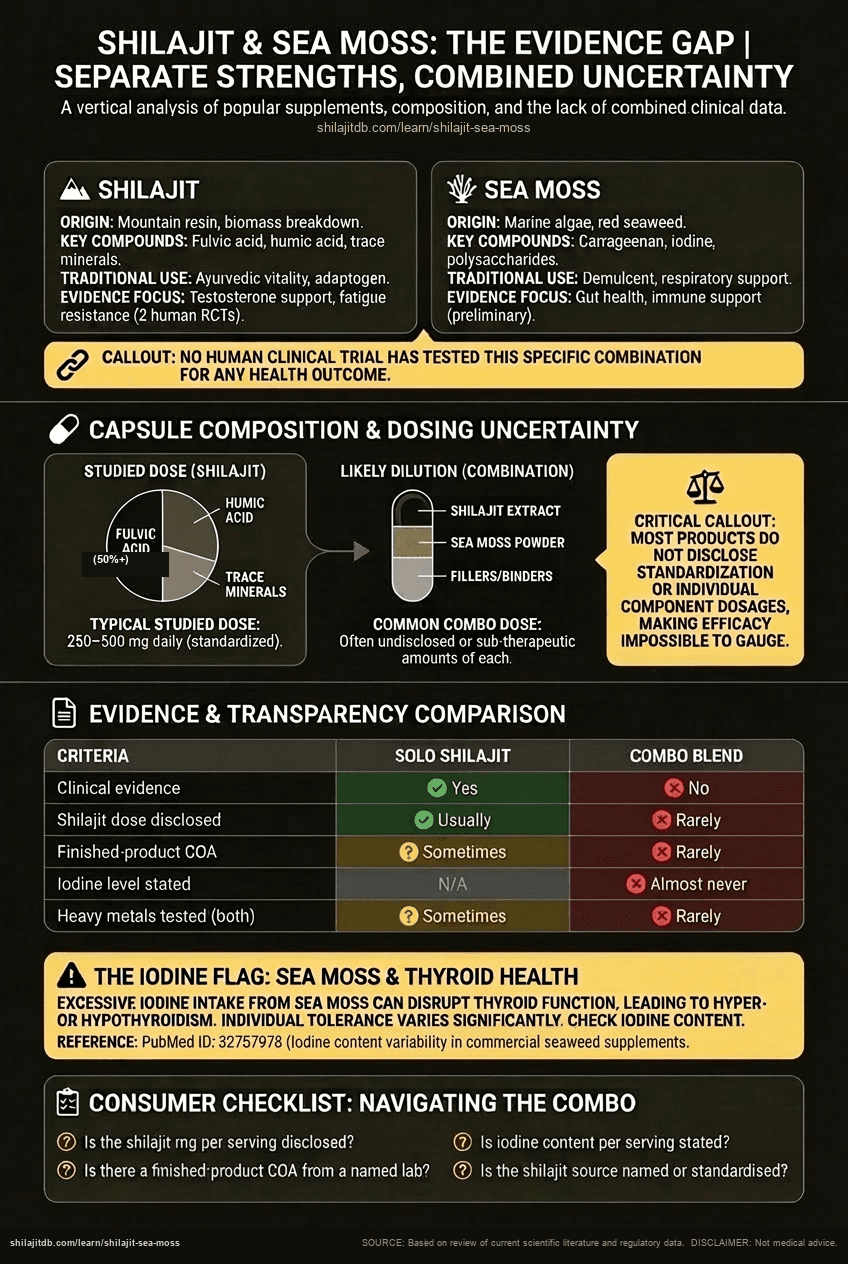
There are no published clinical trials examining the shilajit and sea moss combination in humans. The synergy claim is a marketing construction, not an evidence-based one. That doesn't make the combination harmful — it makes it unverified. You would be taking two ingredients for which the evidence is independent, on the assumption (not the demonstrated fact) that they complement each other.
Why Combo Products Are a Transparency Problem
When you combine shilajit with sea moss — or with ashwagandha, tongkat ali, or any other ingredient — you introduce layered transparency problems that do not exist with solo shilajit products.
Dose dilution
A capsule has a fixed total mass — typically 500–700 mg. If that capsule contains shilajit, sea moss, ashwagandha, and black pepper extract, the shilajit content might be 100–150 mg — well below the 250–500 mg/day used in clinical research. Most combo product labels do not disclose individual ingredient amounts, listing instead a "proprietary blend" with a total weight. You cannot evaluate whether you're getting a meaningful dose of either ingredient.
COA complexity
A meaningful Certificate of Analysis for a shilajit product tests for heavy metals, fulvic acid content, and microbial safety in the finished product. Adding sea moss introduces iodine, additional heavy metal exposure pathways (algae concentrate environmental heavy metals from seawater), and additional microbial risk. A COA for the finished combo product needs to cover all of these — but most combo brands either publish no COA at all, or publish a COA for the shilajit ingredient only, leaving the sea moss component untested.
Heavy metals from both directions
Shilajit and sea moss both carry heavy metal risk from their source environments — shilajit from mineral-rich geological deposits, sea moss from marine environments that may contain lead, arsenic, cadmium, and mercury from ocean pollution. A combo product that has tested only the shilajit component has not addressed the sea moss contamination pathway. A finished-product COA covering both is the minimum standard — and it is rarely provided.
Transparency comparison: solo vs. combo shilajit products
| Criteria | Solo shilajit | Shilajit + sea moss blend |
|---|---|---|
| Clinical evidence for the product | Yes (at studied doses) | No combination studies |
| Shilajit dose per serving disclosed | Usually | Rarely (proprietary blend) |
| COA covers full finished product | Sometimes | Rarely |
| Sea moss iodine level stated | N/A | Almost never |
| Heavy metals tested (both ingredients) | Sometimes | Rarely |
Who Should Be Cautious
The combination is not inherently dangerous, but specific populations should take care:
- Anyone with thyroid conditions. The highly variable iodine content of sea moss supplements makes them unpredictable for thyroid function. Hashimoto's thyroiditis and Graves' disease are both sensitive to iodine excess. Without a stated iodine amount per serving, a sea moss blend is not appropriate for people with thyroid conditions.
- Pregnant and breastfeeding women. Both shilajit and sea moss lack safety data in pregnancy. The heavy metal risk from untested combo products is amplified. Neither ingredient is recommended during pregnancy or breastfeeding.
- People on blood thinners. Carrageenan in sea moss has mild anticoagulant properties. Combined with other medications that affect clotting, this may be relevant.
How to Evaluate a Shilajit and Sea Moss Product
If you want both ingredients, the most transparent approach is to take them separately — a well-documented shilajit product alongside a tested sea moss product — so you can verify the dose and safety of each independently. If you prefer a combo for convenience, apply these minimum criteria:
- Individual ingredient amounts must be disclosed. A proprietary blend total weight is not sufficient. You need to know the mg of shilajit per serving (ideally 250–500 mg to approach studied doses) and the mg of sea moss per serving.
- A COA must cover the finished product. Not just the shilajit ingredient. The COA should show numeric heavy metal values for the finished blend, from a named independent laboratory.
- Iodine content should be stated. A responsible sea moss product discloses its iodine content per serving so buyers can assess their total daily iodine intake against the safe upper limit (1,100 mcg/day for adults per NIH).
- The shilajit source should be named. "Shilajit extract" from an unnamed supplier, diluted into a blend, cannot be verified. A named standardised shilajit ingredient is a better signal.
The Bottom Line
Shilajit has meaningful clinical evidence at adequate doses. Sea moss has limited but promising evidence for gut health and carries a real iodine risk if the content isn't disclosed. The combination has no clinical evidence and introduces compounded transparency problems — lower shilajit doses, absent finished-product COAs, and uninvestigated iodine levels — that make most shilajit-sea moss products harder to evaluate than solo shilajit.
That doesn't make the combination wrong. Both ingredients are legal, generally well-tolerated in reasonable amounts, and have a long history of traditional use. But if you are taking shilajit for its studied benefits — testosterone support, fatigue resistance, mineral supplementation — a solo shilajit product with a public COA and a stated dose is more likely to deliver what the evidence promises than an underdosed, untested blend.
See which shilajit products pass our testing standards
Every product in the database is rated on COA quality, named lab, and numeric heavy metal results. Combo products are graded on the same criteria — and most don't pass.
Open the database →