Shilajit Honey Sticks: What's Actually in Them?
Last reviewed June 2026 · 9 min read
Shilajit honey sticks are single-serve honey sachets — typically 10–20 grams of raw or infused honey — with shilajit added. They've become one of the fastest-growing formats in the shilajit market: convenient, sweet, travel-friendly, and visually appealing on social media. They are also the format in the ShilajitDB database with the lowest rate of dose disclosure and the fewest public Certificates of Analysis.
That combination — high popularity, low documentation — is worth examining closely before you buy.
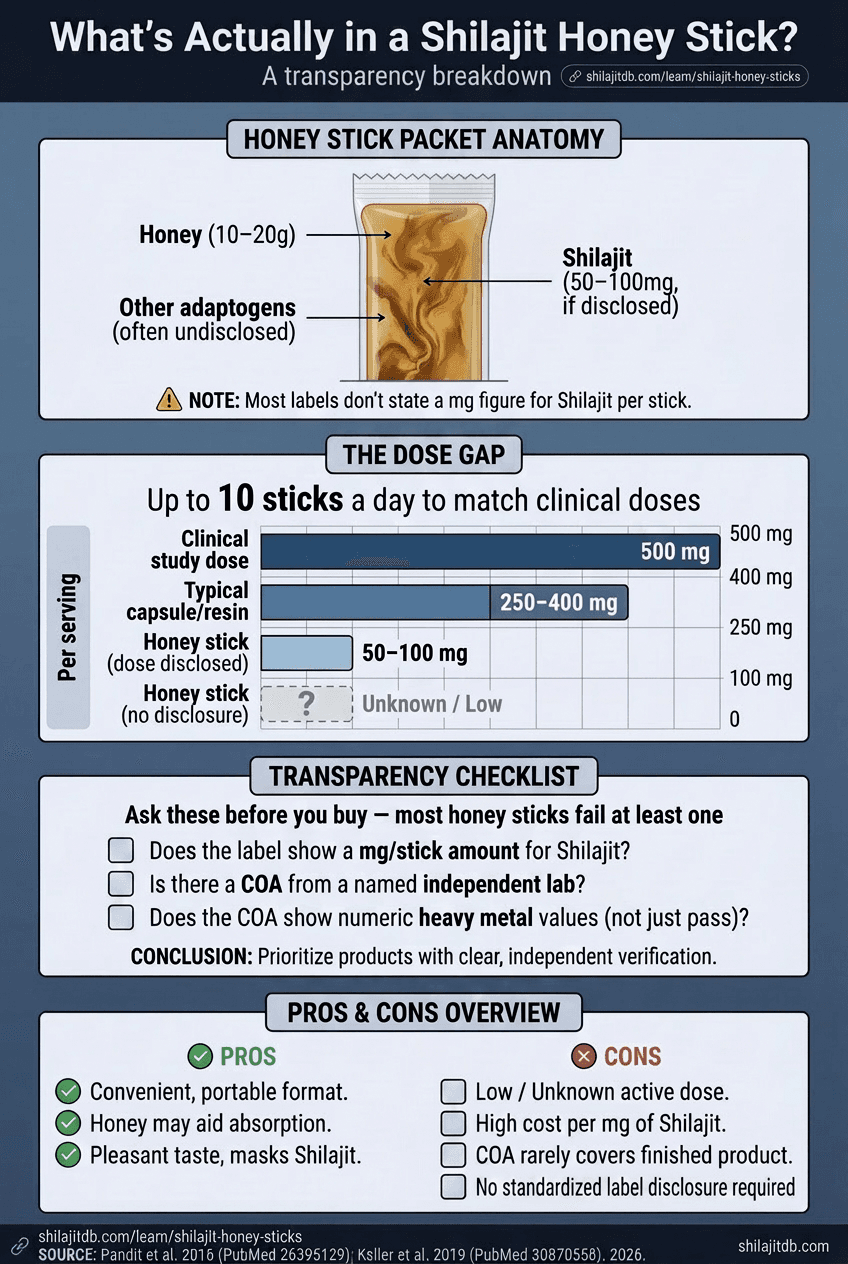
What a Honey Stick Actually Is
A shilajit honey stick is not a standardised product category. There are at least three distinct formulations on the market:
- Raw honey + shilajit resin blended in. The purest version: shilajit resin is dissolved into raw honey and portioned into individual stick packets. Shilajit mixes well with honey — both are viscous, water- soluble compounds blend at room temperature, and the pairing is traditional in Ayurvedic practice.
- Honey + shilajit extract powder. Dried shilajit extract is blended into honey. This is more shelf-stable and cheaper to produce than using resin. The standardisation of the extract varies significantly by supplier — fulvic acid content is rarely stated on the label.
- Honey blend with shilajit plus other ingredients. Many honey sticks include sea moss, ashwagandha, tongkat ali, maca, or other adaptogens alongside shilajit. The shilajit content in these blends is typically even lower, and COA coverage for the finished blend is rare.
The Dose Problem
The clinical studies on shilajit used specific, standardised doses. The two most rigorous randomised controlled trials used:
- 250 mg twice daily (500 mg/day) — Pandit et al. (2016), which found significant increases in total testosterone, free testosterone, and DHEAS in healthy men aged 45–55 over 90 days. PubMed 26395129
- 500 mg/day — Keller et al. (2019), which found attenuation of fatigue-induced strength decline and lowered baseline serum hydroxyproline over 8 weeks in healthy active men, within the stronger half of the sample. PubMed 30728074
Both studies used independently verified, standardised shilajit preparations — not honey sticks. The doses were 250–500 mg of shilajit per day.
How honey sticks compare to clinical doses
| Format | Typical shilajit per serve | % of clinical dose |
|---|---|---|
| Clinical study (Pandit 2016) | 250 mg × 2 | 100% |
| Honey stick (dose disclosed, typical) | 50–100 mg | 10–20% |
| Honey stick (dose not disclosed) | Unknown | Unknown |
| Shilajit resin (typical serving) | 200–400 mg | 40–80% |
| Shilajit capsule (typical serving) | 200–500 mg | 40–100% |
Honey stick dose figures are drawn from publicly available product labels. Most honey stick brands do not disclose a mg figure; the table reflects brands that do.
The arithmetic is straightforward: a honey stick containing 50 mg of shilajit would require 10 sticks per day to match the lower end of the studied dose range — along with 100–200 grams of honey (roughly 300–600 calories of sugar). A honey stick containing 100 mg would require five per day to approach 500 mg. Neither is a realistic daily protocol.
This doesn't mean honey sticks are worthless. A lower dose of a high-quality shilajit may still provide some benefit, and the honey matrix may enhance absorption (see below). But buyers should be clear-eyed: if you are taking honey sticks because you saw clinical evidence about shilajit's effects on testosterone or fatigue, the dosing in that research was not honey stick dosing.
The Disclosure Problem
Most honey stick brands do not state how much shilajit is in each stick. The label typically reads something like: "Raw Wildflower Honey, Shilajit Extract" with no milligram figure. This is legal — there is no FDA requirement to disclose per-serving amounts of individual supplement ingredients within a food product — but it makes it impossible for buyers to assess dosage.
Among honey stick brands in the ShilajitDB database:
- A minority disclose a per-stick shilajit amount in milligrams.
- Of those that do, the disclosed amounts typically fall well below the 250–500 mg/day range used in clinical research.
- Brands that include multiple active ingredients (sea moss, ashwagandha, etc.) alongside shilajit almost never break out the individual ingredient amounts.
A brand that doesn't state the dose is a brand that cannot be held accountable for the dose. This is a transparency concern, not a safety concern — underdosing is not dangerous — but it matters if efficacy is why you're buying.
The COA Problem
A Certificate of Analysis from an independent laboratory is the primary way to verify that a shilajit product contains what it claims and is free of unsafe levels of heavy metals. The COA format matters — a meaningful COA shows actual numeric values for lead, mercury, arsenic, and cadmium, not just a pass/fail stamp.
Testing a honey product is more complex than testing a resin or capsule:
- Matrix interference. The sugar matrix in honey can interfere with ICP-MS and other heavy metal assays unless labs use specific sample preparation protocols (acid digestion, dilution). Not all labs that test supplements routinely are set up for honey matrices. This increases the cost and complexity of testing.
- Ingredient vs. finished product testing. A brand may have a COA for the shilajit ingredient sourced from their raw material supplier — but this is not a COA for the finished honey stick product. The finished product COA matters because it reflects what you're actually consuming, including any contribution from the honey or other ingredients.
- Concentration calculation. If a honey stick contains 100 mg of shilajit in a 15 g stick, the heavy metal concentrations in the finished product will be roughly 1/150th of what they would be in the raw shilajit. This is not a cause for alarm — it is actually a safety advantage of the format — but it means finished-product COA results for honey sticks are not directly comparable to resin or capsule COA results.
Despite these complexities, most honey stick brands do not publish any COA — not for the finished product, and sometimes not even for the underlying shilajit ingredient. This is the most significant transparency gap in the honey stick category.
Does the Honey Matrix Help or Hurt Absorption?
The honest answer is that no clinical data addresses this question directly. But the mechanistic case is reasonable:
- Fulvic acid is water-soluble. The primary bioactive compound in shilajit, fulvic acid, dissolves readily in water — and honey, being a concentrated sugar syrup, is a liquid carrier. There is no reason to expect poor absorption.
- Traditional pairing. Shilajit has been consumed with honey in Ayurvedic tradition for centuries. Traditional formulations like Chyavanprash include both shilajit and honey. While tradition does not establish bioavailability, it suggests the combination is not antagonistic.
- Enzymatic concerns. Raw honey contains enzymes including glucose oxidase, which generates hydrogen peroxide as a byproduct. Whether this affects shilajit compounds at physiologically relevant concentrations is unknown. Standard pasteurised honey used by most commercial brands would not have this variable.
The honest conclusion: the honey matrix is probably a neutral-to-positive carrier for shilajit compounds. The absorption problem is not the format — it's the dose.
What Honey Sticks Are Actually Good For
Setting the dose and COA concerns aside, honey sticks do have genuine advantages:
- Convenience. No measuring, no jar, no spatula. A packet fits in a pocket, a gym bag, or carry-on luggage. For travellers or people who struggle to make resin part of a daily routine, the format removes friction.
- Palatability. Raw shilajit resin has a strong, distinctive flavour — bittersweet, mineral, slightly smoky. Many people find it unpleasant. Honey masks the taste almost entirely. For anyone deterred by the taste of resin, honey sticks offer a genuine on-ramp.
- Low barrier for occasional use. If you are not pursuing a clinical protocol but simply want some shilajit exposure alongside the nutritional benefits of raw honey, a honey stick is a reasonable format — provided it discloses its shilajit content and comes from a brand with verifiable sourcing.
The format is not the problem. The transparency gap around the format is the problem — and it is solvable. A honey stick brand that disclosed its per-stick shilajit content, used a named standardised shilajit ingredient (PrimaVie or equivalent), and published a COA for the finished product would be a meaningfully different product from most of what is currently on the market.
Heavy Metals and Honey Sticks
The heavy metals risk in shilajit relates to the source material: improperly purified shilajit can contain elevated levels of lead, arsenic, mercury, and cadmium. The dilution effect of honey means the absolute mg-per-serving exposure from a honey stick is lower than from resin or capsules — but this only matters if the shilajit ingredient itself was tested.
An untested shilajit ingredient diluted into honey is safer than an untested shilajit ingredient taken straight, but "less exposure to potentially unsafe levels" is not the same as "safe." The right question is not whether the dilution makes you safer; it is whether the shilajit ingredient passed independent heavy metal testing in the first place.
What to Check Before Buying a Honey Stick
Apply the same criteria you'd apply to any shilajit format, plus format-specific questions:
- Is the per-stick shilajit amount disclosed? If the label doesn't state a milligram figure, you can't evaluate dose. This alone should lower your confidence in the product.
- Is the shilajit ingredient named or standardised? A named standardised ingredient (e.g. PrimaVie® shilajit, which specifies ≥50% fulvic acid and has independent safety data) is a better signal than "shilajit extract" from an unnamed supplier.
- Is there a public COA? Ideally for the finished product. At minimum, for the shilajit ingredient. Numeric heavy metal values, not just pass/fail. See why numeric values matter.
- Is the lab named? A COA from an unnamed or in-house lab is difficult to verify. Recognisable accredited labs (e.g. Eurofins, NSF, Silliker, ALS) provide more confidence.
- What is your goal? If you are taking shilajit to replicate the outcomes in clinical research, assess whether the honey stick format can realistically deliver the required dose. If you want a convenient, tasty daily supplement, a honey stick from a transparent brand is a reasonable choice.
The Bottom Line
Shilajit honey sticks are the most searched shilajit format and the least documented. The format has genuine advantages — convenience, palatability, and a plausible honey carrier for fulvic acid compounds. The problems are specific and correctable: most brands do not disclose per-stick dose, most do not publish a COA for the finished product, and the amounts that are disclosed rarely approach the doses used in clinical research.
Before buying, ask three questions: How much shilajit is in each stick? Is there a COA from a named independent lab? And is the dose per stick close enough to 250–500 mg/day to matter for your goals? If a brand can't answer the first two, the third is irrelevant.
See which products pass our testing standards
Filter by COA status, named lab, and heavy metals testing. Only products with public third-party Certificates of Analysis are graded Premium or above.
Open the database →