Best Time to Take Shilajit: Morning, With Food, or Pre-Workout?
Last reviewed May 2026 · 7 min read
"When should I take shilajit?" is one of the most common questions about the supplement — and one of the least directly studied. No published randomised controlled trial has compared morning versus evening dosing, or fasted versus fed timing, as a primary variable. What the research does give us is the dosing protocols used in successful trials, the absorption pharmacology of fulvic acid, and enough circadian physiology to make sound, goal-specific recommendations. That is what this article covers.
What Clinical Trials Actually Used
Before reasoning about optimal timing, it helps to know what timing was used in the trials that demonstrated shilajit's benefits. The short answer: most used twice-daily dosing, and none identified timing as a variable worth testing.
- Pandit et al. (2016) — 250 mg purified shilajit twice daily for 90 days. Produced statistically significant increases in total and free testosterone versus placebo in healthy men aged 45–55 (the abstract gives no effect sizes). PubMed 26395129.
- Surapaneni et al. (2012) — 25–100 mg/kg daily for 21 days in a rat model of chronic fatigue, dosed once a day. Shilajit attenuated fatigue-related behaviour and preserved mitochondrial markers. Animal work, included here because it is so often quoted as a human dosing protocol — it is not one. PubMed 22771318.
- Keller et al. (2019) — 500 mg once daily for 8 weeks in 63 healthy active men. Attenuated strength decline during fatiguing leg extensions and lowered baseline serum hydroxyproline, within the stronger half of the sample; 250 mg/day did nothing. PubMed 30728074.
The takeaway: 250 mg twice daily is the protocol behind the hormonal and fertility results. Once-daily dosing (500 mg) was used for the exercise study. Neither format specified a time of day. Anything more specific than this is extrapolated from mechanism.
The Case for Morning
Morning is the most commonly recommended time to take shilajit, and the reasoning is sound even in the absence of direct trial evidence.
Circadian cortisol alignment
Cortisol — the body's primary stress-regulation hormone — follows a pronounced daily rhythm called the cortisol awakening response (CAR). Cortisol peaks sharply within 30–45 minutes of waking, typically reaching its highest level between 7:00 and 9:00 AM, then declines throughout the day. Shilajit is classified as an adaptogen: a substance that helps modulate the stress response system. Taking an adaptogen during the period of highest adrenal activity is physiologically logical — you are supporting a system that is already active, rather than stimulating it at rest.
Fasted absorption advantage
Fulvic acid — shilajit's primary bioactive compound — is water-soluble and does not require dietary fat for absorption. Dissolving resin in warm water first thing in the morning, before food, allows the compound to reach intestinal absorption surfaces without competing with other nutrients. There is no pharmacokinetic study on fulvic acid absorption timing in humans, but the water-solubility profile supports the logic of a fasted morning dose. For people with sensitive stomachs, taking shilajit with a small meal eliminates any GI discomfort without meaningfully impeding absorption.
Practical adherence
All three of the major shilajit RCTs ran for 8–12 weeks. The studies showing benefit were daily supplementation studies, not acute dosing studies. Consistency over months is what drives outcomes. Morning routines have higher adherence rates than evening ones in supplement research, simply because the morning sequence (wake, coffee, vitamins) is a more stable daily pattern than evenings, which vary. The best time to take shilajit is ultimately the time you will remember every day.
Timing by Goal: Quick Reference
| Goal | Recommended timing | Rationale |
|---|---|---|
| Testosterone / hormonal support | Morning + midday (split dose) | Matches Pandit et al. protocol (250 mg × 2) |
| Energy / fatigue reduction | Morning, fasted or with breakfast | Aligns with cortisol peak; energy effects welcome early |
| Exercise performance | 30–60 min pre-workout | Mitochondrial support active during training window |
| Iron / mineral absorption | With meals, away from tea/coffee | Fulvic acid chelates minerals; tannins compete |
| General wellness / longevity | Any consistent time, preferably morning | Adherence matters more than precision |
With Food or Without?
This is the second most common timing question, and the answer is more flexible than many supplement guides suggest.
Shilajit resin is typically dissolved in 100–200 ml of warm water or milk. In this form, the active compounds — primarily fulvic acid and dibenzo-α-pyrones (DBPs) — are already in solution before they enter the stomach. This distinguishes it from fat-soluble supplements (like vitamin D or K2) where food fat genuinely matters for absorption.
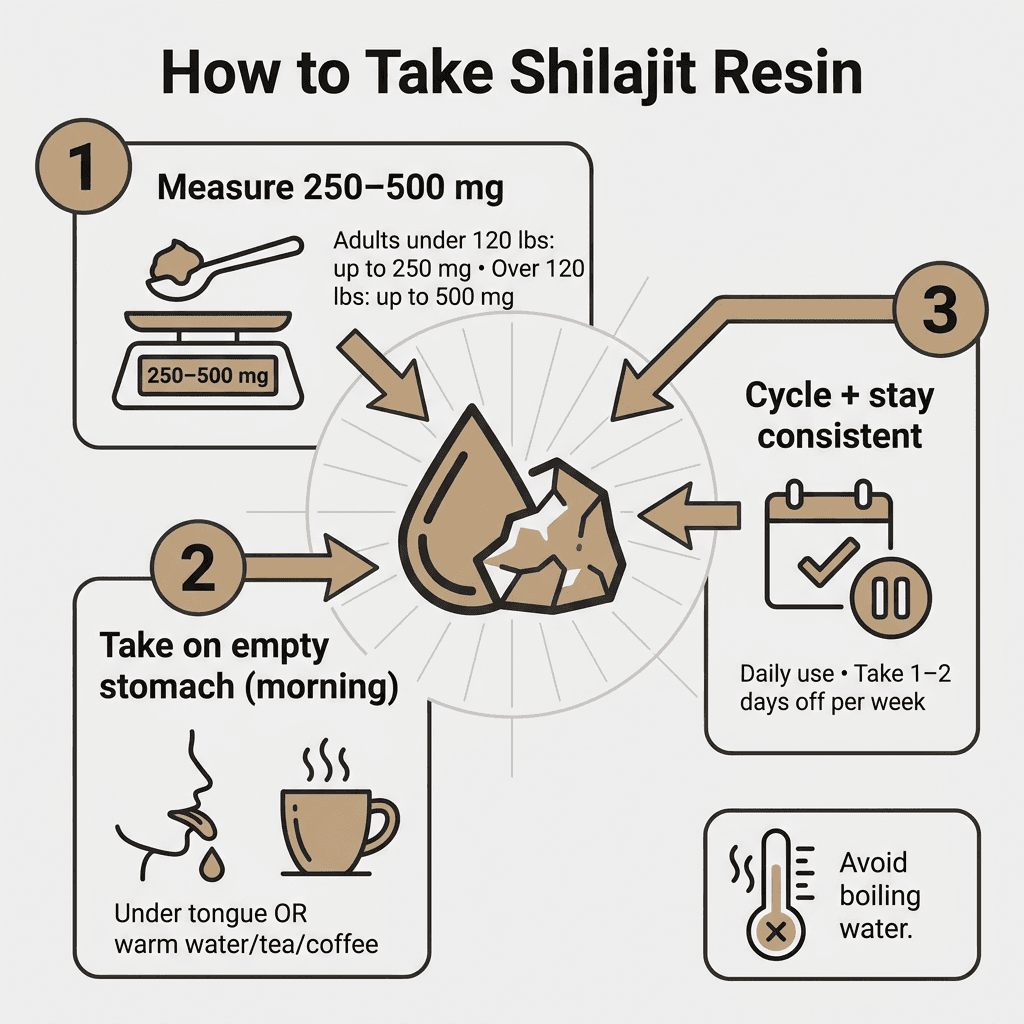
The practical guidance: if you have a sensitive stomach, take shilajit with a small meal to avoid nausea. If not, fasted is fine. Avoid taking it immediately alongside a very high-calcium meal (e.g., a large dairy-heavy breakfast), as calcium may compete with the mineral co-factors in shilajit for transporter sites in the small intestine. A 30-minute gap resolves this.
Capsule-form shilajit behaves similarly. The shell delays release, so the timing relative to food matters even less than with resin. Take capsules with water and a small amount of food if gastric sensitivity is a concern.
Should You Split the Dose?
If your target dose is 500 mg/day — the upper range of clinical protocols — splitting it into two doses of 250 mg (morning and midday) is both the most clinically supported approach and physiologically sensible.
Split dosing maintains more consistent circulating levels of fulvic acid and its metabolites throughout the day. The Pandit et al. testosterone study — still the most methodologically rigorous human trial on shilajit's hormonal effects — used exactly this protocol: 250 mg in the morning and 250 mg in the evening over 90 days. The Biswas fertility study split 100 mg twice daily the same way.
If you choose to split doses: morning and midday is preferable to morning and evening. Some users report difficulty sleeping when taking shilajit in the evening, likely due to its mild energising effects. There is no trial data confirming this, but the anecdotal pattern is consistent enough that taking the second dose after 3:00 PM is not recommended unless you have tested your individual response.
A Day in Practice
6–8 AM
First dose
250 mg resin dissolved in warm water. Before or with breakfast. Wait 30 min after coffee.
12–1 PM
Second dose (if splitting)
250 mg with lunch or just before. Keeps afternoon levels consistent.
3 PM+
Cut-off point
Avoid dosing after mid-afternoon if you are sensitive to shilajit's energising effects.
Pre-workout
Alternative morning slot
Take 30–60 min before training if exercise performance is the primary goal.
Pre-Workout Timing
Shilajit is not a stimulant in the conventional sense — it contains no caffeine and does not acutely raise heart rate or blood pressure. Its exercise-relevant mechanism is mitochondrial: fulvic acid and DBPs support electron transport chain efficiency, which translates to better sustained energy production during high-output exercise. This is a background effect, not an acute spike.
The Keller et al. (2019) trial used 500 mg/day of shilajit in healthy active adults and demonstrated attenuation of exercise-induced strength decline after 8 weeks — not an acute session-to-session effect. The authors did not test pre-workout versus other timing. The implication is that timing relative to workouts matters less than daily consistency.
That said, taking shilajit 30–60 minutes before training is a reasonable approach if you train in the morning, because it aligns your supplementation with your workout window while maintaining the morning cortisol synergy. Avoid stacking it with high-dose caffeine or other stimulant pre-workouts if you are new to shilajit — assess your individual response first.
What to Space Apart
Take shilajit at least 30 minutes away from these
Coffee and black tea
Tannins bind to minerals — including the ionic minerals shilajit contributes — and reduce their bioavailability. Wait until your coffee has cleared, or take shilajit first.
High-dose iron supplements
Fulvic acid chelates iron and changes its oxidation state. Taking both simultaneously may unpredictably alter iron speciation. Space at least 1–2 hours apart.
Calcium-heavy meals or supplements
Calcium competes with zinc and magnesium for intestinal transporter sites. Shilajit's mineral complex absorbs better 30 minutes before or after dairy-heavy meals.
Antihypertensive medications
Shilajit may modestly lower blood pressure. If you take medication for hypertension, consult your physician before adding shilajit. Do not adjust medications independently.
Evening Use: What to Know
Some people take shilajit in the evening without issue. Others report difficulty falling asleep. The mechanism is not stimulant-mediated — shilajit does not contain caffeine or known adenosine antagonists. The most likely explanation is indirect: improved mitochondrial energy production in the hours after dosing keeps some individuals at a higher baseline arousal state at bedtime.
If you want to test evening dosing, a 60 mg dose — the lower bound of studied dosages — is a reasonable starting point. Track your sleep quality for one week. If there is no disruption, a standard dose is likely fine for you at that time. If sleep degrades, move the dose earlier. This is not a published protocol; it is practical experimentation within a well-established safety range.
Consistency Outweighs Precision
The most important timing variable in the human shilajit trials was not morning versus evening — it was duration. Pandit et al. ran 90 days. Biswas ran 90 days. Keller ran 8 weeks. None measured meaningful short-term effects. Shilajit is not a supplement where acute timing optimisation changes the outcome. The compound's mechanisms — mitochondrial support, mineral bioavailability, adaptogenic modulation — are cumulative effects that develop over weeks of consistent daily use.
The practical recommendation: pick a time that fits naturally into your existing daily routine. For most people that is the morning, with or just before breakfast. Pair it with something you already do — preparing coffee, taking other supplements, eating breakfast — so it becomes automatic. A dose taken at 7 AM every day for 12 weeks will produce better outcomes than the "optimal" timing applied inconsistently.
Bottom line
- → Morning, fasted or with a light meal is the best default for most people.
- → Split dosing (morning + midday) matches the clinical protocols that showed hormonal and fatigue benefits.
- → Pre-workout (30–60 min before training) is a sound option if you train in the morning.
- → Avoid late evening if you are sensitive to the energising effects.
- → Space 30+ minutes from coffee, tea, and iron supplements.
- → Consistency over 8–12 weeks is what the evidence says matters most.
Find a verified shilajit to take consistently
Timing only matters if what you're taking is authentic. Browse products graded on COA quality, lab accreditation, and heavy metal testing.
Open the database →